
NCERT Solutions Class 9 Science Chapter 10
Chapter 10 – Gravitation
Question 1. State the universal law of gravitation.
Solution : According to Newton’s universal law of gravitation :
Every mass in this universe attracts every other mass with a force which is directly proportional to the product of two masses and inversely proportional to the square of the distance between them.
Question 2. Write the formula to find the magnitude of the gravitational force between the earth and an object on the surface of the earth.
Solution : The formula to find the magnitude of the gravitational force between the earth and an object on the surface of the earth is given below:

F = magnitude of gravitational force
G = Universal gravitation constant
M = mass of earth
m = mass of object
d = distance of object from the centre of earth
Question 3. What do you mean by free fall?
Solution : It is the object falling towards earth under the influence of attraction force of earth or gravity.
Question 4. What do you mean by acceleration due to gravity?
Solution : During free fall any object that has mass experiences force towards centre of earth and hence an acceleration works as well. “acceleration experienced by an object in its free fall is called acceleration due to gravity.” It is denoted by g.
Question 5. What are the differences between the mass of an object and its weight?
Solution :
| S. No. | Mass | Weight |
| I. | Mass is the quantity of matter contained in the body. | Weight is the force of gravity acting on the body. |
| II. | It is the measure of inertia of the body. | It is the measure of gravity. |
| III. | Mass is a constant quantity. | Weight is not a constant quantity. It is different at different places. |
| IV. | It only has magnitude. | It has magnitude as well as direction. |
| V. | Its SI unit is kilogram (kg). | Its SI unit is the same as the SI unit of force, i.e., Newton (N). |


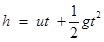
 = 245 – 122.5 = 122.5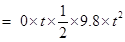
 = 160 – 80 = 80 m


 = 4.9 m